Vertexprotocol combined trading and lending through shared margin before its exchange closed
Last updated
Vertexprotocol combined spot trading, perpetual futures and lending in one cross-margin decentralized exchange before its 2025 closure. Cross-margin meant eligible balances and positions shared collateral within an account. The exchange launched on Arbitrum in 2023 and later connected chain deployments through Vertex Edge. Its hybrid design paired an off-chain orderbook with on-chain settlement. Trading ended during July 2025 following the team’s agreement to join the Ink Foundation.
Shared collateral and borrowing power
Eligible balances and outstanding liabilities jointly determined how much additional risk a cross-margin account could take while the exchange operated. A deposit could support several positions within that account. Borrowing and trading losses consumed the same shared capacity.
The risk engine applied asset-specific weights to balances and positions when calculating account health. Their contribution therefore differed from their unadjusted market value. Oracle prices, position direction and the applicable risk settings affected that calculation. Unrealized gains could support margin elsewhere in the portfolio, while losses reduced the available buffer. This connected spot holdings, derivatives and borrowing without requiring separate collateral allocations for every product.
Initial health governed the capacity to increase risk. Maintenance health determined the remaining buffer against liquidation. An account could lose the ability to open additional exposure before it became eligible for liquidation.
Shared collateral also exposed supporting balances to losses elsewhere in that account. The overall portfolio needed enough weighted margin to support its liabilities. A profitable position did not make the remaining portfolio immune to liquidation. Later perpetual trading also offered isolated margin, which allocated collateral to an individual position.
Orderbook matching and on-chain settlement
An off-chain sequencer matched orders against available liquidity, while on-chain contracts maintained the exchange’s balances, positions and risk calculations. This division separated fast order matching from blockchain settlement. It also made the matching service an operational dependency alongside the contracts and underlying chain.
Limit orders and pooled liquidity
The central limit orderbook combined resting buy and sell orders with liquidity from the integrated automated market maker, or AMM. A limit price constrained acceptable execution prices. It did not create a counterparty or guarantee that the entire order would fill. Available liquidity and the order’s remaining quantity still affected execution.
Contract balances and signing access
Deposited collateral moved into protocol contracts and supported the account recorded there. A connected wallet authorized actions; its ordinary token balance was separate from its exchange collateral. The trading interface and SDK provided different ways to interact with the same protocol. The SDK included order management, collateral operations and account queries.
Spot balances and perpetual exposure
Spot trading changed asset balances, while perpetual trading created derivative exposure with profit or loss tied to a market’s price movements. Both contributed to shared margin in cross-margin accounts. Their economic consequences differed, even when they concerned the same underlying asset.
Spot holdings and borrowed assets
A positive spot balance represented an asset held within the protocol account. Spot margin trading also involved the integrated money market: borrowed assets appeared as liabilities alongside the account’s holdings. This supported leveraged spot exposure without treating the borrowed amount as additional net wealth. Ownership of a spot balance and the obligation to repay a borrow therefore needed separate treatment in account valuation.
Perpetual positions and funding
A perpetual position provided long or short price exposure without a scheduled contract expiry. Funding adjusted the economics of holding that position as perpetual and reference prices diverged. Depending on its direction and the funding rate, a position could pay or receive funding. Its unrealized profit or loss also affected account margin. Holding a derivative did not amount to holding the underlying spot asset.
Lending balances and liquidity provision
Lending and market-making supplied capital for different exchange functions. The money market supported borrowing, while liquidity providers supplied capital that supported trading.
Deposit interest and borrow interest
Eligible positive balances could earn lending interest through the integrated money market, while borrowing created interest-bearing liabilities. The spot engine tracked deposits and borrows with separate cumulative interest accounting. Borrowing rates depended on market utilization and configured interest parameters. Deposit returns also reflected utilization and the protocol’s interest fee. Rates therefore changed with the market’s state. Margin capacity and lending returns described different properties of a balance: its ability to support positions and the interest that it accrued.
Pool shares and orderbook capital
Native spot pools required both pool assets and issued liquidity-provider tokens representing a share of the pool. Those positions contributed to weighted account health. Pool composition and value could change, so fee earnings did not establish a fixed principal value. Elixir’s Fusion Pools provided a separate route for supplying capital to algorithmic market-making on the orderbook. Supplying liquidity also differed from lending an asset to the money market.
Execution fees and carrying costs
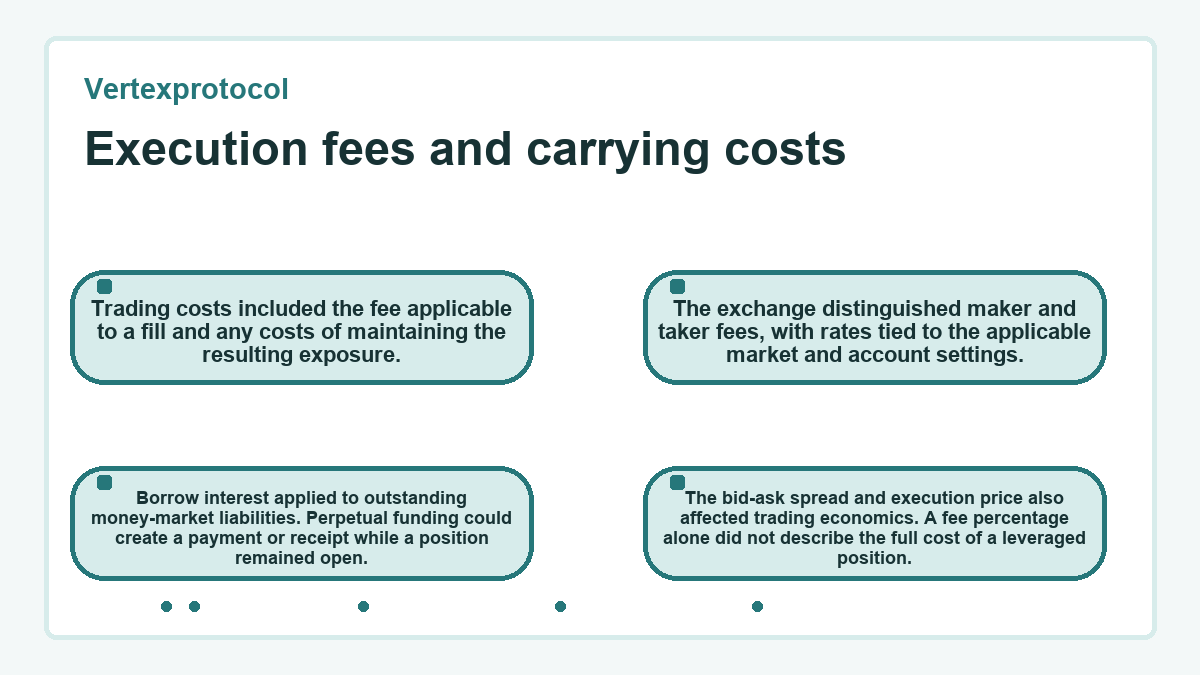
Trading costs included the fee applicable to a fill and any costs of maintaining the resulting exposure. The exchange distinguished maker and taker fees, with rates tied to the applicable market and account settings. Borrow interest applied to outstanding money-market liabilities. Perpetual funding could create a payment or receipt while a position remained open. The bid-ask spread and execution price also affected trading economics. A fee percentage alone did not describe the full cost of a leveraged position.
Offsetting exposure within a shared account
A historical portfolio illustration
In this hypothetical historical case, an account held a spot asset and a short perpetual covering an equal quantity of the same underlying asset. Both positions belonged to one cross-margin account, and the products formed a configured linked pair. Assume their prices fell by matching amounts while both positions remained open. Could the derivative gain help support the declining spot holding?
Under those assumptions, the spot holding lost market value and the short perpetual gained unrealized value. The clearinghouse combined their health contributions and applied the configured spread adjustment to the overlapping exposure. The gain could therefore support margin in the account as the spot holding declined.
This offset reduced directional exposure under the stated assumptions; it did not establish a positive net return. Differences between spot and perpetual prices, funding and any borrowing costs remained relevant. Closing one leg removed that particular offset. Keeping the legs in different accounts would also remove their shared contribution to one account’s health.
Vertex Edge and settlement across chains
Vertex Edge shared resting orderbook liquidity between connected chain deployments while preserving native settlement on each participating chain. Arbitrum was the original deployment, and the network later included deployments such as Base. The distinction concerned liquidity access: an order could match against a combined book without requiring the trader to move to the counterparty’s chain.
The sequencer handled opposing positions across chain instances and rebalanced liquidity on the backend. Shared matching therefore did not mean every user’s collateral occupied one chain or one global wallet account. Each deployment still relied on its own contracts and chain settlement. Edge addressed fragmented trading liquidity, while cross-margin addressed how positions and balances supported risk within an account.
When did Vertexprotocol stop trading?
Vertexprotocol’s announced trading cutoff was July 16, 2025 at 14:00 UTC. The final shutdown phase also called for disabling borrowing, deposits and withdrawals.
The wind-down began on July 8. Under the schedule, perpetual markets would enter reduce-only mode on July 10, when their oracle prices would freeze. That mode allowed positions to decrease or close.
The plan specified forced settlement of remaining perpetual positions on July 14 using the frozen oracle prices. Money markets would then switch to repay-only mode. Spot markets would continue operating until final closure.
The plan called for closing outstanding borrows through collateral swaps, with a 5% penalty for those remaining after July 16, 2025 at 14:00 UTC. It also specified direct wallet returns of settlement funds. Those planned returns were separate from ordinary withdrawals through the retired trading interface.
The Ink transition and VRTX’s ended utility
The July 2025 agreement brought the team and core infrastructure into the Ink Foundation, with plans for a new exchange built for Ink. It also sunset VRTX, the former exchange’s token. The announced INK allocation used the July 8, 2025 snapshot at 14:00 UTC. It included staked and unstaked VRTX, excluding treasury holdings and non-vested tokens. Token eligibility and the settlement of trading balances were separate matters.
VRTX balances could remain visible in wallets after the acquisition. Their former utility ended, including staking rewards and buybacks. A wallet balance therefore no longer provided access to the original exchange’s token benefits.
Everyday questions about Vertexprotocol
Was one-click trading mandatory on Vertexprotocol?
Vertexprotocol’s one-click trading mode was optional. The operating exchange also allowed users to sign individual actions manually. One-click trading used a linked signing key to authorize actions within the app, reducing repeated wallet prompts. Deposits remained outside that authorization shortcut. This was a choice of signing mode within the former service, and it did not remove the account’s margin requirements.
Where was the one-click signing key stored?
The one-click trading implementation stored its signing key in the browser’s local storage. The app used it to sign authorized exchange actions on the user’s behalf. Clearing that storage required enabling the feature again. This delegated key was separate from the connected wallet’s private key.
Did accounts under the same wallet share collateral?
Separate Vertexprotocol accounts under one wallet maintained separate positions and risk management. Each ordinary account could be cross-margined internally, while another account’s collateral remained outside that shared calculation. Grouping accounts under one wallet simplified access without combining their margin.
How did isolated perpetual margin differ from a separate Vertexprotocol account?
An isolated perpetual position had its own collateral allocation, while an ordinary separate account could still contain cross-margined positions. Vertexprotocol offered isolated perpetuals alongside default cross-margin before its closure. The multiple-account feature kept accounts under one wallet separate from each other, without changing every position into an isolated-margin position.
Did Vertexprotocol accept any token held in a connected wallet?
Vertexprotocol accepted collateral through configured spot products on the relevant deployment. A token’s presence in a wallet did not establish its eligibility. Contract configuration mapped supported products to token addresses and accounted for their decimal precision. Support on one chain also did not establish support on another deployment. These collateral rules described the exchange while deposits were operational.
How long was trade history intended to remain accessible after shutdown?
The 2025 shutdown plan provided approximately four additional weeks of trade-history access after trading stopped. This temporary record-retrieval window did not keep trading, deposits or withdrawals open.
Is an order digest proof of a completed Vertexprotocol trade?
An order digest identified order data and did not prove that Vertexprotocol had executed a trade. The SDK exposed digest creation separately from historical-match queries. Execution records concerned actual filled amounts, which could differ from the submitted order’s full quantity. Signing an order authorized its data; the signature alone did not establish submission, acceptance or a complete fill.