Vertexprotocol token migration tied INK eligibility to a historical VRTX snapshot
Last updated
Vertexprotocol token migration linked the announced INK airdrop to eligible VRTX holdings in the July 8, 2025 snapshot. The plan paired the VRTX sunset with the team’s agreement to join the Ink Foundation. Holding the old token, qualifying for an allocation and receiving INK were different states within the transition.
VRTX eligibility and INK delivery
For holders covered by the snapshot, the planned INK distribution depended on their eligible VRTX balance and the separate launch of the new token. A snapshot recorded holdings at a specified time. An allocation assigned a share of the airdrop. Distribution delivered that share through the applicable route.
The July 2025 agreement brought the exchange’s team and infrastructure into the Ink ecosystem. It paired the VRTX sunset with an INK airdrop and boosted participation in a separate incentives program.
The July 8 snapshot cutoff
The migration snapshot recorded VRTX holdings on July 8, 2025, at 14:00 UTC. Later purchases could not increase holdings recorded at that cutoff. The same distinction applied to a wallet’s later balance: it showed what the wallet held then, without establishing what it held at the snapshot. The cutoff fixed the historical input for eligibility; it did not establish the token’s delivery date.
A later balance with an unresolved historical holding
Consider a hypothetical holder whose wallet displays VRTX after the cutoff, but whose records do not establish a snapshot balance.
The missing record prevents the holder from estimating an allocation from their historical VRTX balance. Buying more VRTX cannot repair that gap. The planned wallet allocation check could show the assigned INK amount even without the holder’s own snapshot records.
The July 2025 plan described the following progression. These were dependencies between holdings and delivery, not a series of token transfers that every holder had to perform.
| Announced milestone | Allocation and delivery conditions |
|---|---|
| VRTX snapshot | The recorded holdings determined the historical balance under consideration. |
| Eligibility determination | Treasury holdings and non-vested VRTX remained outside the airdrop. |
| Allocation verification | The plan provided for allocation checks through eligible wallets. |
| INK token launch | The plan tied claims to launch; exchange distribution also depended on listing. |
| Claim or exchange distribution | The plan assigned claims to holders and customer distributions to participating exchanges. |
| Receipt | A displayed allocation and an INK wallet receipt or exchange credit represented different states. |
An allocation display would resolve the quantity assigned to that holder, while delivery would require the corresponding receipt. If launch or distribution conditions remained unmet, the holder would still be waiting for delivery.
The July plan required no VRTX transfer from holders to establish their snapshot-based allocation. Sending the old token elsewhere would not supply the missing historical holding.
Treasury exclusions and vesting status
The announced exclusions removed treasury holdings and non-vested VRTX from the airdrop, so an apparent token balance alone did not establish an eligible holding. The exclusion concerned VRTX vesting status; the July plan said INK would be fully vested and liquid at launch. The snapshot concerned the time at which holdings were recorded. A recorded holding could therefore remain excluded because of its treasury or vesting classification.
The planned burn applied to the excluded treasury and non-vested holdings. Eligible holders’ allocations depended on the qualifying snapshot balance, without a requirement to burn their VRTX.
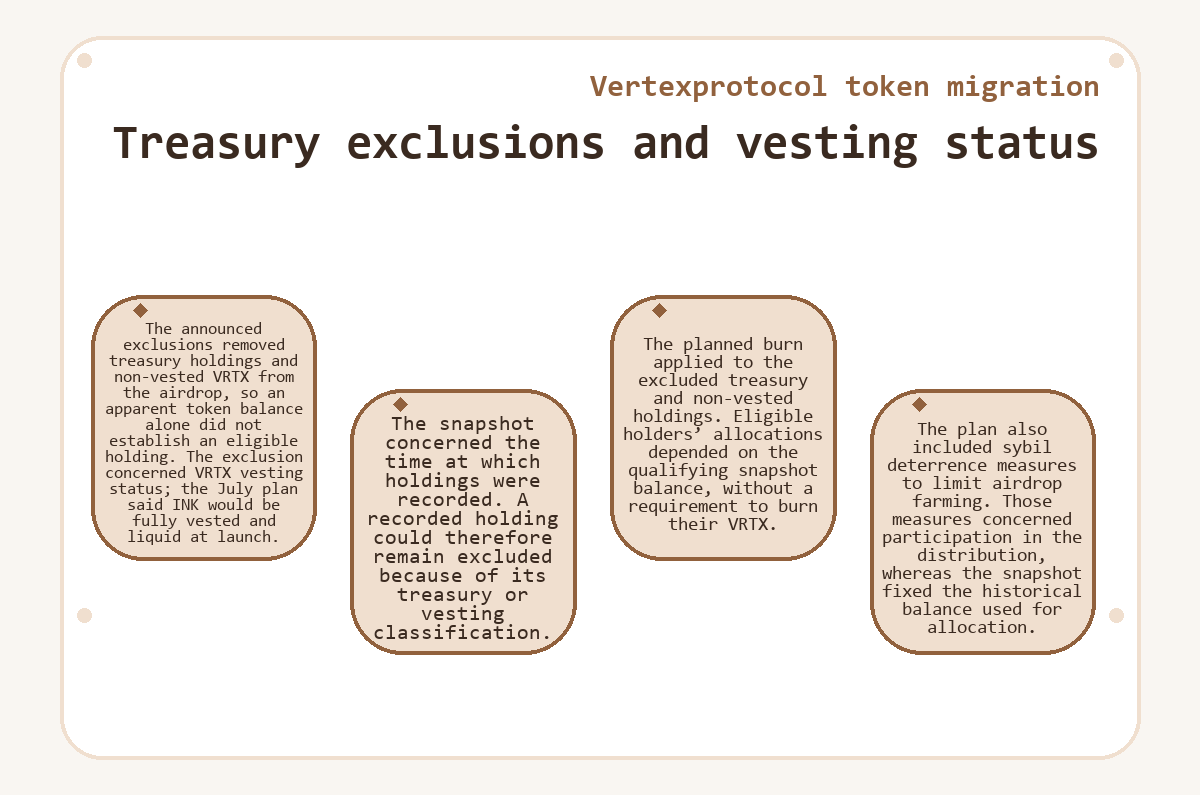
The plan also included sybil deterrence measures to limit airdrop farming. Those measures concerned participation in the distribution, whereas the snapshot fixed the historical balance used for allocation.
The community pool and individual token quantities
The size of the announced community allocation described the combined pool for eligible holders, while an individual allocation concerned that holder’s share of the distribution. The July 2025 plan allocated 1% of the total INK supply to the VRTX holder airdrop. The denominator was the total INK supply. It was not the holder’s portfolio value or a percentage return on VRTX.
A token quantity also differed from a monetary value. An allocation denominated in INK established units of that token. It did not establish a cash payment, a redemption value or the value of the old VRTX holding. The July 2025 plan quoted approximately 0.018 INK per eligible VRTX.
Exchange custody and customer distribution
The July plan routed centralized-exchange allocations through participating exchanges. The Ink Foundation would send INK for customer distribution, conditional on launch and the exchange’s INK listing. Exchange custody changed who could establish the customer’s credit. A personal wallet balance and an exchange account balance were different records of control. Where an exchange held the tokens, a customer credit was the relevant account outcome. A distribution to the exchange alone did not demonstrate that every customer’s account had received its allocation.
Did the snapshot date start the INK claim window?
The July 2025 terms set a 90-day claim window beginning at INK launch, so the snapshot date did not start that period.
A calendar deadline therefore required the applicable launch date. Counting from the acquisition announcement or snapshot would use the wrong starting event.
Historical VRTX records after the sunset
Historical VRTX holding and reward records concerned units of the old token, even after its sunset. The July 2025 plan stated that VRTX would remain visible in wallets but lose all utility, including staking rewards and buybacks. A reward figure described VRTX rewards; a recorded holding described a VRTX balance. Neither record itself represented an INK distribution.
Trading-account assets and the move to Ink
The Ink agreement changed the exchange’s operating environment and token plan, while trading-account withdrawals concerned assets already held inside the exchange. The transition announced the cessation of trading across the existing EVM deployments and a new exchange planned for Ink. The new exchange plan and the holder airdrop belonged to the same transition, with separate conditions for availability and distribution.
Collateral returned through a withdrawal or account settlement concerned the existing trading account. The INK allocation depended on VRTX holdings at the snapshot. Account funding, closing positions and settling borrowed assets did not by themselves establish an INK receipt. An old account settlement could return collateral without delivering any INK.
Questions worth asking
-
Did staked VRTX need to be unstaked before the migration snapshot?
- The snapshot included eligible staked and unstaked VRTX, so unstaking was not a prerequisite for the announced INK allocation.
-
What conversion rate did the July 2025 VRTX-to-INK plan announce?
- The July 2025 plan quoted approximately 0.018 INK per eligible VRTX; this expressed token units, not a cash exchange rate.
-
Was the 2024 staking upgrade the same migration as the INK airdrop?
- The November 2024 V1-to-V2 upgrade moved VRTX staking positions between staking systems, while the July 2025 plan sunset VRTX and allocated INK. Completing the older staking upgrade did not establish delivery of the later INK airdrop.
-
Does a VRTX rewards balance in the old Python SDK show how much INK arrived?
- The Python SDK’s 0.1.0 reference described VRTX rewards queries, which returned reward information for the specified wallet. Those records concerned VRTX rewards from the old system. An INK receipt concerned a separate token distribution, so the VRTX rewards response alone did not establish the quantity of INK delivered.
-
What happened to unclaimed INK under the announced migration terms?
- The announced plan assigned unclaimed INK to redistribution after the launch-based claim period, so it did not reserve allocations indefinitely.