Vertexprotocol required deposits to complete additional account setup
Last updated
Vertexprotocol required a deposit to complete additional account creation in its August 2024 web app. Naming an account and choosing an avatar left setup unfinished until funding arrived. An unfunded account disappeared after the app was closed or refreshed. Each account had separate positions and risks under the same wallet. This onboarding flow preceded the exchange’s July 2025 shutdown.
The account selector determined the destination, while token allowance and deposit processing controlled different parts of funding. A transaction confirmation and the account’s credited balance could therefore answer different questions. Preparation could stop before the deposit transferred assets.
In the August 2024 app, naming an additional account did not complete setup; funding determined whether the account persisted.
Wallet access and the intended deposit destination
A connected wallet identified the owner, while the account selector identified the particular trading account that would receive a deposit. The August 2024 interface exposed account selection through the Portfolio page and Account Center. Creating an additional account involved its own name and avatar. Those display choices helped distinguish accounts, although funding remained necessary to finish creation.
The active selection governed deposits, trading information and account history in the web app. Its green dot marked the selected account. A wallet address therefore provided less information than the combination of that address and its chosen account. During setup, the destination needed to match the account being created.
Shared margin within an account and separation between accounts
Additional accounts had separate positions and risks, with cross-margin calculated within each account. Allocating capital across accounts split the available collateral even though the same wallet controlled them. Keeping eligible positions together preserved their shared margin calculation. This gave account organization a financial consequence beyond its name or avatar: assets assigned to another ordinary account did not automatically support the newly created one.
The funding requirement in the August 2024 app
In the August 2024 creation flow, refreshing or leaving the app before funding caused additional account setup to restart. A name and avatar could appear during preparation without establishing a persistent funded account. The deposit supplied the assets that completed that creation flow.
Assets held in the connected wallet remained outside the exchange account until deposited. Their appearance in a wallet balance did not establish collateral in the new account. Funding also had a different purpose from choosing a market or submitting an order. Completing account setup did not require opening a trading position.
Authorization and the transfer of collateral
Permission to spend a token
Token allowance authorized the deposit contract to spend the relevant assets. The Python SDK exposed allowance approval and allowance queries separately from deposits. Approval established spending permission; it did not itself credit the trading account.
Assets entering the protocol
A direct EVM collateral deposit moved tokens from the depositor through Endpoint to Clearinghouse. The deposit identified the recipient subaccount and the product whose balance would receive credit. Once that transfer succeeded, the assets had entered the protocol. Closing the app afterward could not undo the completed transfer.
Funding-source choices and token amounts
Direct collateral deposits and Checkout
The exchange supported direct collateral deposits and integrated Checkout, powered by FUN, into its deposit interface. Checkout added funding from a preferred token, a centralized exchange or a card.
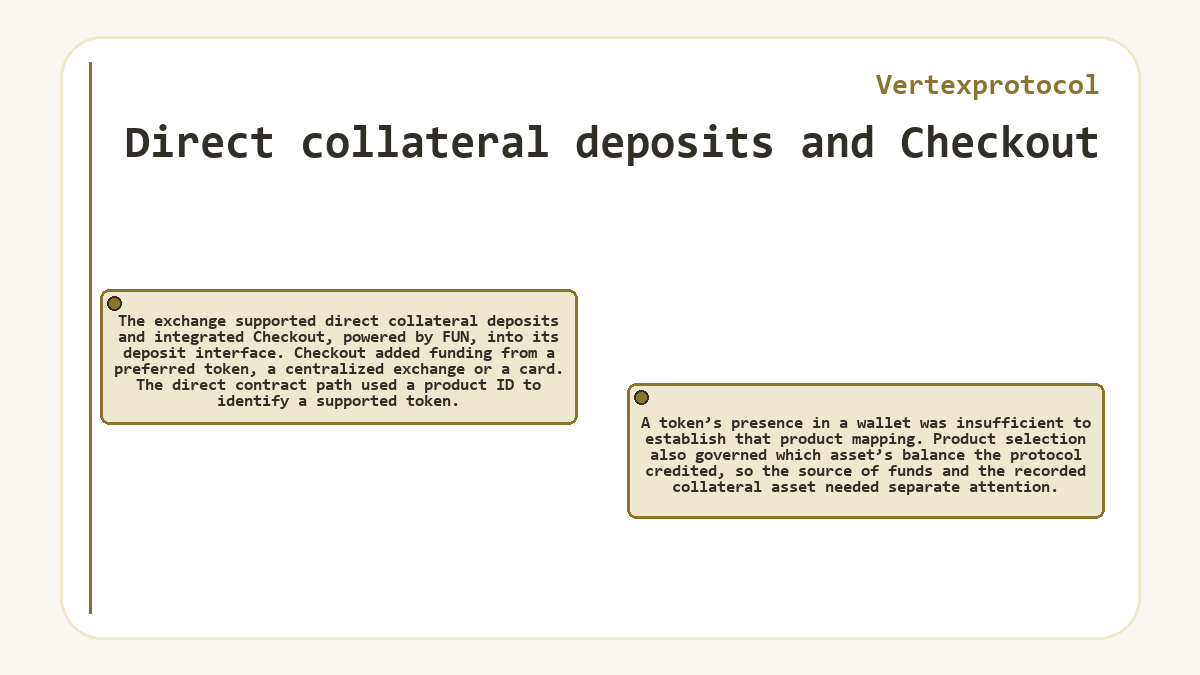
The direct contract path used a product ID to identify a supported token. A token’s presence in a wallet was insufficient to establish that product mapping. Product selection also governed which asset’s balance the protocol credited, so the source of funds and the recorded collateral asset needed separate attention.
Value thresholds and token precision
The published EVM core set a minimum first-deposit value of 5 quote units for an ordinary unregistered subaccount, valuing the quote product at a unit price and other products using the protocol’s price feed. The deposit amount used the token’s smallest units. The check normalized that amount, with a maximum supported token precision of 18 decimals. Different token quantities could meet the same value threshold. For an ordinary unregistered subaccount, a deposit below that threshold was rejected before tokens transferred.
A transaction record and a credited balance
A successful token transfer and a credited subaccount balance described different states in the direct EVM deposit path. Endpoint transferred the assets and queued the collateral entry. Successful processing of that entry recorded the subaccount and applied the deposit to its balance. Blockchain confirmation of the funding transaction alone did not establish that later credit.
The Python SDK 0.1.0 deposit example returned a transaction hash. Its Subaccount API separately exposed an engine summary for a specified subaccount. The hash identified the transaction; the summary described the engine’s account state. Matching the recipient and product mattered because a balance in another account did not answer whether the intended destination received collateral.
The historical interface displayed information for the account marked as active. An unexpected balance could therefore reflect the selected account rather than a failed transfer. Account identity needed to remain consistent when comparing the deposit record with the displayed balance.
A submitted transaction established submission, and a successful receipt established execution of that transaction. A corresponding credited balance established the account’s funding state.
The stop point before committing collateral
A user who wanted to prepare an account without transferring collateral could stop the 2024 setup flow before submitting a deposit. The intended wallet and account could already be selected.
- The selected wallet and new account needed to match the intended deposit destination.
- If funding remained undecided, preparation could stop before allowance authorization and deposit submission.
- A successful collateral transfer marked the point at which assets entered the protocol.
- The transaction result and credited recipient balance needed to be distinguished when recording the outcome.
- On reopening the historical app, the selected account and balance needed to match the funded destination.
An unfunded account that disappeared after a refresh matched the expected unfinished state. A retained name without the intended credited balance did not establish completed funding. After collateral was credited, returning it involved a withdrawal subject to account health and token liquidity. That made stopping before the transfer different from reversing it afterward.
Funding and permission to open a position
A funded account had collateral, while the ability to add trading risk depended on its weighted Initial Health. The Market API handled orders separately from the Spot API’s collateral deposits. This separation allowed account funding and the first trade to remain distinct decisions.
The portfolio calculation included eligible balances, positions and liabilities within that account. When Initial Health fell below zero, the account entered Maintenance Mode and could not take additional risk. A positive token balance alone therefore did not establish unrestricted trading capacity. Borrowing and existing positions could change what the same funded balance supported.
The shutdown ended the old onboarding path
The old exchange was wound down following the team’s July 2025 agreement to join the Ink Foundation. The announced shutdown schedule set July 16, 2025 at 14:00 UTC as the start of the phase in which deposits would be disabled. Account-creation instructions from 2024 described the earlier operating exchange.
The transition also addressed VRTX token migration and plans for a new DEX on Ink. Trading-account funding and token-holder eligibility concerned different conditions. Depositing after the holdings snapshot could not change the balances captured at that earlier time. A later application could use different funding requirements or account controls, changing the setup procedure that applied to its users.
Frequently asked questions
How many accounts did Vertexprotocol allow under one wallet at the August 2024 launch?
The August 2024 web app allowed up to four accounts under the same wallet address. The count should not be confused with limits for isolated perpetual subaccounts or treated as a limit for every protocol interface. Each account retained its own positions and risk management.
Could existing account balances fund a new account at the August 2024 launch?
At the August 2024 launch, new accounts were funded through direct deposits. Transfers between accounts were planned as an additional funding option. A balance in an existing account did not automatically fund the newly named account.
Did an additional Vertexprotocol account require a separate recovery phrase?
An additional trading account belonged to the existing wallet address and did not create another wallet. In the EVM deposit interface, the subaccount identifier combined the wallet address with a subaccount name. Separate positions and balances within the exchange therefore did not require a new recovery phrase for each trading account.
Was a personal referral code mandatory for the standard deposit call?
The standard EVM collateral-deposit call supplied a default referral code automatically. Its referral-aware counterpart required a nonempty value, which was a condition of that particular function. Manually entering a promotional code was therefore unnecessary for the ordinary deposit entry point. A referral parameter and the account’s collateral-funding requirement were separate parts of the deposit operation.
Which wallet supplied tokens when someone deposited for another subaccount?
The EVM deposit function took tokens from the transaction caller, even when the specified recipient was another subaccount. The collateral entry identified that recipient separately. The contract checked both the depositor and the recipient’s wallet against its sanctions mechanism. Supplying assets for a recipient did not change the wallet address encoded in the recipient subaccount.
Were regular account deposits equivalent to Elixir liquidity-pool deposits?
Regular account collateral deposits and Elixir liquidity-pool deposits were different operations. The Elixir integration used VertexManager with depositSpot or depositPerp to allocate liquidity to particular pools. That integration maintained pool shares and processed deposits through its own queue. Funding an ordinary exchange subaccount did not automatically call those pool functions or enroll its balance in that integration.